AI providers — get an API key (OpenAI, Gemini, Claude, Groq…) and add it
🎯 Goal
Connect your own AI account, so the AI chatbot, knowledge-base answers, reply suggestions, summaries and translation all work.
🧰 What you need
- The account owner login (only owners manage keys)
- An account with an AI provider. Most need a card for prepaid credit; Gemini and Groq have free tiers
Why “bring your own key”?
Section titled “Why “bring your own key”?”MeAPI’s AI runs on your AI provider account. You pay the provider directly at their price; MeAPI adds nothing on top. Keys are encrypted and, once saved, never shown again, not even to your agents. Without a key, AI steps simply hand the chat to a person.
Which provider should I pick?
Section titled “Which provider should I pick?”| Provider | Good for | Searches knowledge by meaning | Free tier |
|---|---|---|---|
| Google Gemini | Low cost, strong in Hindi/Gujarati | ✅ | Yes (rate-limited) |
| OpenAI | All-round quality | ✅ | No, prepaid |
| Anthropic Claude | Careful, well-written answers | — | No, prepaid |
| Groq | Very fast, cheap open models | — | Yes (rate-limited) |
| Mistral | Low cost | ✅ | Limited |
| DeepSeek | Very low cost | — | No |
| xAI Grok | Grok models | — | No |
| OpenRouter | One key, hundreds of models | — | Some free models |
| Azure OpenAI | Companies on Azure | ✅ | Azure billing |
| Custom (OpenAI-compatible) | Your own or another OpenAI-style server | ✅ | Depends |
Not sure? Start with Google Gemini. It’s free to try, good with Indian languages, and also powers knowledge-base search. If you answer with Claude, Groq, DeepSeek, xAI or OpenRouter, also add a Gemini, OpenAI or Mistral key. These can’t create “embeddings”, so without one your knowledge bases fall back to keyword search.
Step 1: create the key
Section titled “Step 1: create the key”- Open aistudio.google.com/apikey and sign in with a Google account.
- Click Create API key and pick or create a Google Cloud project.
- Copy the key (it starts with
AIza). - Optional: enable billing on the project for higher limits.
- Open platform.openai.com and sign in.
- Add credit under Settings → Billing. A ChatGPT subscription does not include API use.
- Open API keys → Create new secret key, and name it “MeAPI”.
- Copy the key (it starts with
sk-). It’s shown only once. Optionally set a budget under Limits.
- Open console.anthropic.com and sign up.
- Buy credits under Settings → Billing. A Claude.ai subscription does not include API use.
- Settings → API keys → Create key, and name it “MeAPI”.
- Copy the key (it starts with
sk-ant-).
- Open console.groq.com/keys and sign in.
- Create API Key and copy it (it starts with
gsk_). - The free tier is rate-limited. Upgrade for production volume.
- Mistral: console.mistral.ai/api-keys → choose a plan → Create new key.
- DeepSeek: platform.deepseek.com/api_keys → top up → Create new API key.
- xAI Grok: console.x.ai → add credits → API keys → Create API key.
- OpenRouter: openrouter.ai/keys → Create key, and add credits for paid models. Model names look like
openai/gpt-4.1-mini. - Azure OpenAI: in the Azure portal, create an Azure OpenAI resource and deploy a chat model (and an embedding model). Copy the endpoint, a key from Keys and Endpoint, and the deployment names.
- Custom (OpenAI-compatible): any server with an OpenAI-style API. You need its Base URL (ending in
/v1, public https) and a key.
Step 2: add it in MeAPI
Section titled “Step 2: add it in MeAPI”- Open AI & Knowledge → AI providers.
- Click the provider card (Not connected · click to add a key). A panel opens; Get a key links to the provider’s key page. Paste the API key. For Azure, also enter the endpoint, Chat deployment, Embedding deployment and API version; for Custom, the Base URL.
- Choose the Default model. Click List to load the provider’s models, or type a model name. Cheaper “mini”, “flash” or “haiku” models are plenty for customer replies. For providers that can embed, also pick the Embedding model (knowledge bases).
- Optional: Your price per 1M tokens (input and output, in $) for cost estimates. Blank uses the provider’s list price where known.
- Click Save & test. MeAPI sends a tiny test request and shows the status: Working, Key rejected, Out of credit or Error. Test again re-checks later; the Enabled switch turns a key off without deleting it; Delete removes it (bots using it fall back to your default provider).
- Under Which key does what, choose the Default for replies, suggestions, summaries, translation and the provider for Embeddings (knowledge-base search). Automatic picks one of your keys that can embed. Bots can pick their own provider and model.
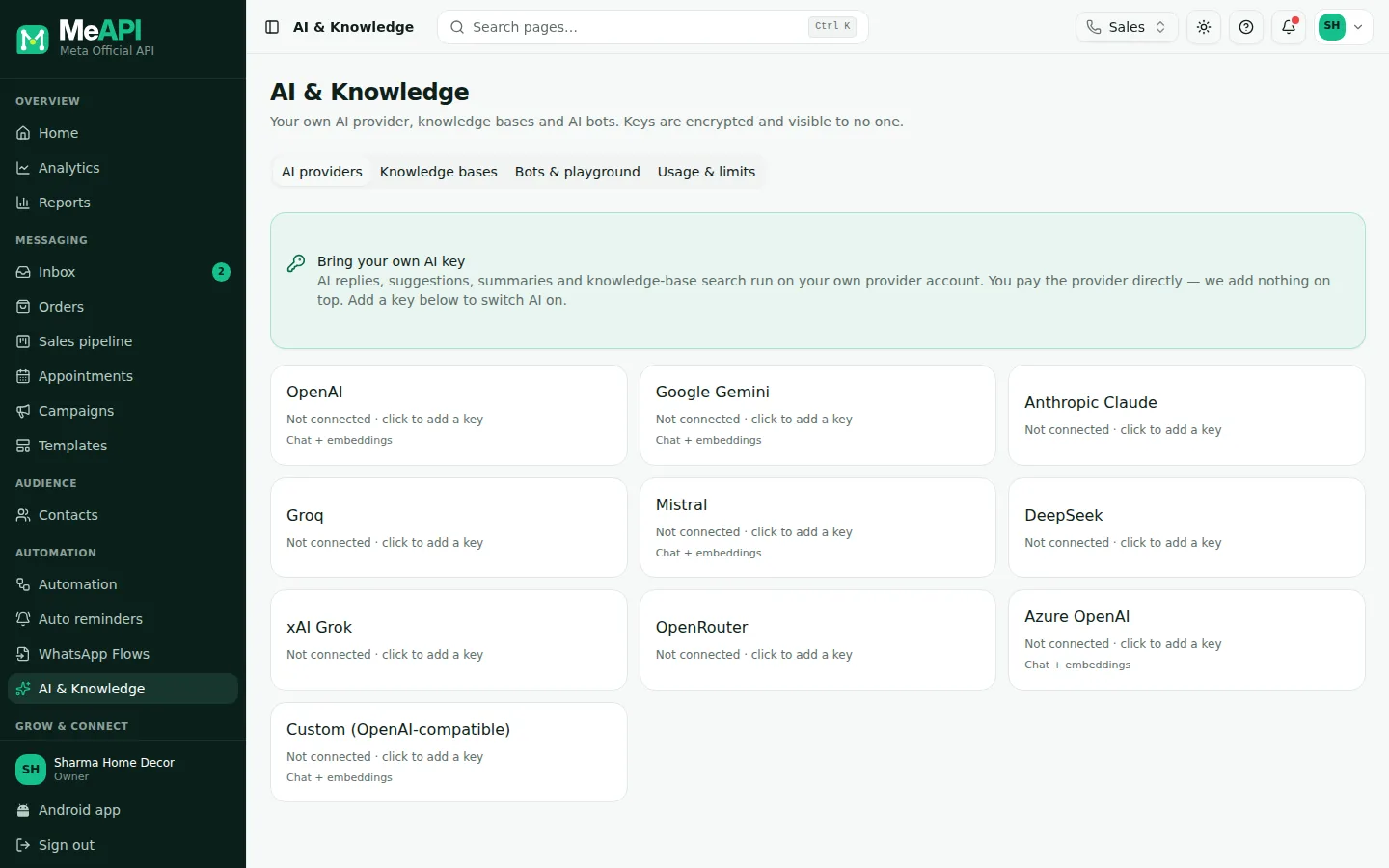
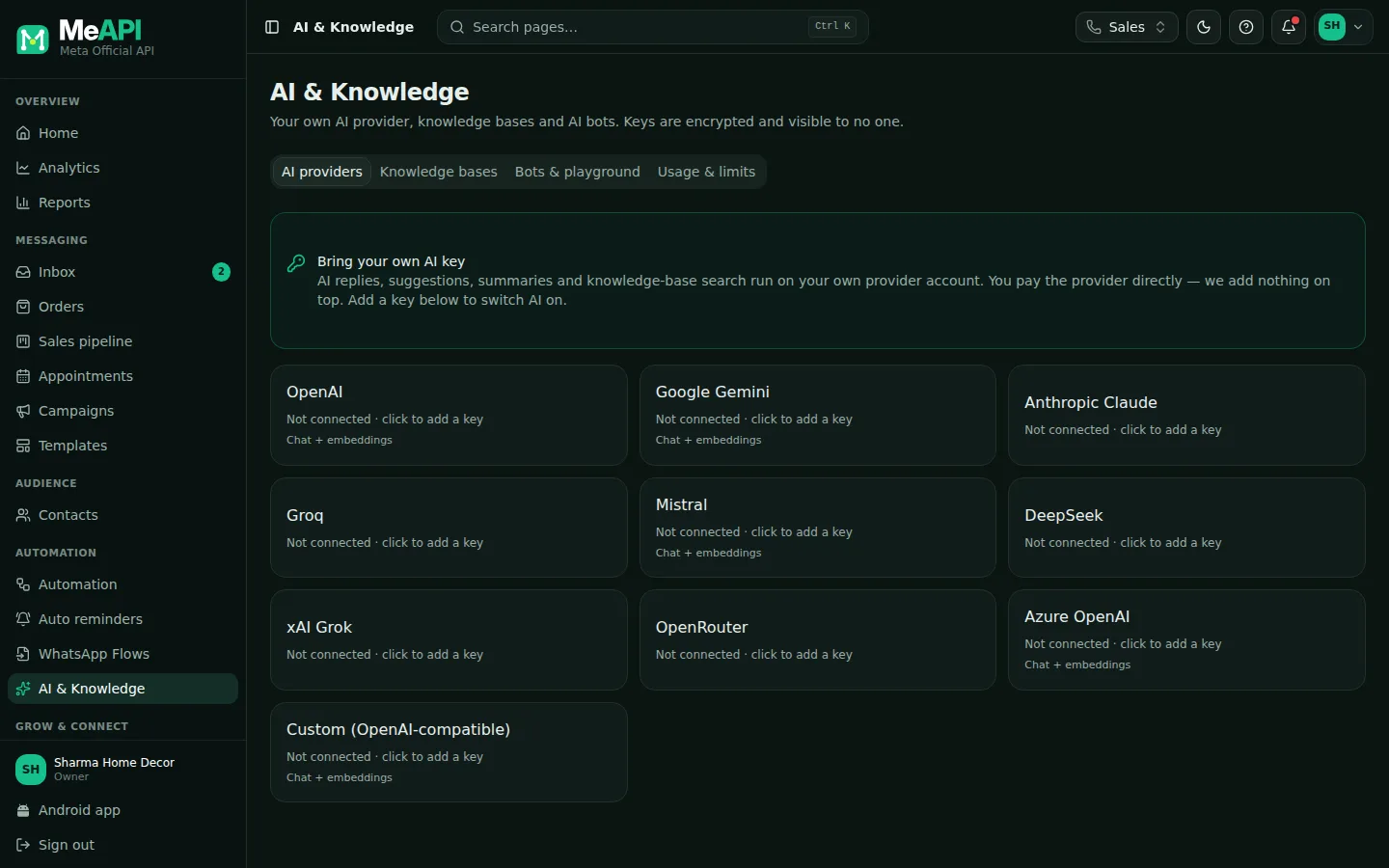
- Tabs: AI providers, Knowledge bases, Bots & playground, Usage & limits (agents see only the middle two).
- One card per provider. A connected card shows its status (Working, Not tested, Key rejected, Out of credit, Error), the end of the key and the model. Default marks the default provider; Off a disabled key; Chat + embeddings those that can power knowledge search.
- Which key does what: the default provider for replies, suggestions, summaries and translation, and the provider for embeddings (Automatic by default).
Common mistakes
Section titled “Common mistakes”- Using a ChatGPT Plus or Claude Pro subscription. Those don’t include API access. Buy API credit separately.
- “Out of credit” status. Top up at the provider; AI resumes automatically.
- Knowledge search feels weak with Claude/Groq. Add a Gemini or OpenAI key for embeddings, then Re-index all.
What’s next
Section titled “What’s next”Was this page helpful?
Thank you — we read every comment.
Could not send right now. Please try again later.
© 2026 MeAPI by TheWebStore028 · RADHAMADHAV WEBSTORE LLP · GSTIN 27ABJFR6148J1ZO · Contact us ·Cookie settings